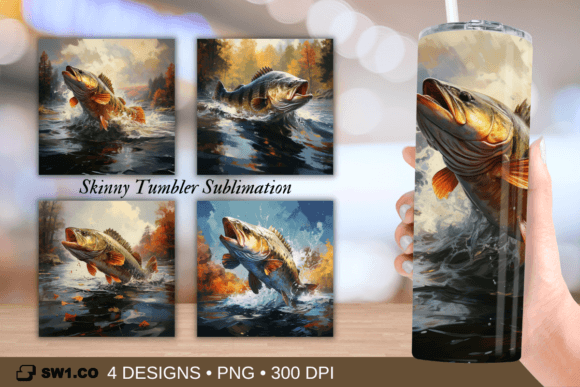
Watercolor Bass Fish Tumbler Sublimation
A Designer’s First Look: Soft, Playful, and Surprisingly Versatile
When I opened the Watercolor Bass Fish Tumbler Sublimation file, my first thought wasn’t “fishing gear”—it was “summer porch, iced tea, and a relaxed vibe.” The design leans into watercolor’s natural softness: blurred edges, gentle pigment blooms, and a subtle sense of movement in the bass’s tail. It’s not hyper-realistic or technical—it’s expressive, friendly, and intentionally imperfect. That’s a huge plus for embroidery designers who know that rigid line art often fights the needle, while organic shapes like this tend to translate beautifully into satin stitch curves and layered fill stitches.
Real Project Test: Embroidering a Custom Linen Tote for a Local Fish Hatchery Pop-Up
Last month, I used Watercolor Bass Fish Tumbler Sublimation as the centerpiece for a limited-run embroidered tote bag—part of a collaboration with a conservation-minded small shop. We chose natural linen canvas (medium weight, slightly textured) and paired it with muted olive and slate-gray thread. The result? A handmade product that felt intentional, not mass-produced. Customers paused at the booth—not just because of the fish, but because the watercolor effect translated so well into stitch: soft gradients mimicked by staggered fill stitch density, and the fish’s eye held just enough detail without demanding tiny, high-risk satin stitches. It worked because the design didn’t try to be everything—it knew its lane: approachable, seasonal, and quietly confident.
Where This Design Shines (and Where It Asks for Thought)
Watercolor Bass Fish Tumbler Sublimation excels on medium-to-heavy fabrics where stitch definition stays clean: sweatshirt embroidery, cotton aprons, pillow covers, and structured tote bags. Its moderate scale and open negative space make it ideal for custom apparel meant to feel personal—not promotional. I’ve also seen it work well as an embroidered patch when digitized with balanced stitch density; the watercolor flow reads clearly even at 3.5” wide.
But here’s what I watch closely:
- Small hoop sizes: The full wrap layout isn’t built for tight hoops—plan to crop or reposition for caps or baby onesies unless you’re adapting it intentionally.
- Stretchy or thin fabric: On lightweight knits or jersey, the soft edges can blur further under tension. Use cutaway + tear-away stabilizer combo, and consider simplifying outer contours if stitching on t-shirts.
- Dark backgrounds: Since it’s a sublimation-ready PNG, the design assumes light-to-mid tone substrates. On charcoal or navy fabric, test thread contrast first—some watercolor washes fade visually without strong tonal separation.
- Frequent-wash items: While the shape holds up fine, avoid placing it on high-friction zones like towel hems or backpack straps unless stitch density is verified for durability.
What It Adds to Your Craft Business—Beyond the Stitch
This isn’t just another digital embroidery file. Watercolor Bass Fish Tumbler Sublimation carries mood—and mood sells. Etsy sellers report stronger engagement on listings where it’s styled with rustic wood mockups or paired with handwritten tags (“Catch & Carry”). For boutique branding, it lends warmth without cliché—think nursery decor, kitchen towels for a lakefront B&B, or holiday gifts for outdoor-loving clients. It builds customer trust because it feels hand-selected, not algorithm-generated. And yes—it lifts perceived value: a $28 embroidered tea towel feels like a keepsake when the bass has that gentle, painterly lift.
Practical Notes Every Embroidery Designer Should Run Through
Before cutting fabric or loading your machine, treat Watercolor Bass Fish Tumbler Sublimation like any serious design asset:
- Test on scrap fabric *with your exact thread and stabilizer*—watercolor illusions live or die by thread sheen and fabric tooth.
- Check stitch density in the gill area and tail fin—those are common hotspots for puckering if over-digitized.
- Confirm hoop size compatibility: the original wrap format suggests horizontal orientation, so rotate or resize mindfully for vertical applications like cap fronts.
- Inspect small details in black-and-white mockups—does the fish retain character without color cues?
- Compare performance on light vs. dark fabric previews—especially if offering custom apparel through your craft business.
- Verify licensing: since it’s listed under Graphics and Crafts, confirm whether commercial embroidery rights are included before selling finished embroidered products or bundling it into digital kits.
Final Thought: A Quietly Confident Design Choice
Watercolor Bass Fish Tumbler Sublimation won’t shout from a crowded craft fair table—but it will draw people in, slow them down, and make them smile. That’s rare. In a landscape full of sharp-edged logos and over-rendered wildlife, this design trusts the process: the watercolor bleed, the stitch variation, the handmade imperfection. It works because it doesn’t fight embroidery—it invites it. Whether you’re prepping a personalized gift, building a cohesive Etsy collection, or sourcing design assets for a small shop’s seasonal line, this one earns its place in your working library. Just remember: let the watercolor breathe, stabilize with intention, and stitch like you mean it—not perfectly, but thoughtfully.